
Guide summary
Riding Tights Manufacturers
Research-led sourcing guidance for equestrian buyers, retailers, brands and manufacturers — connected directly to relevant EquiGuild supplier discovery.
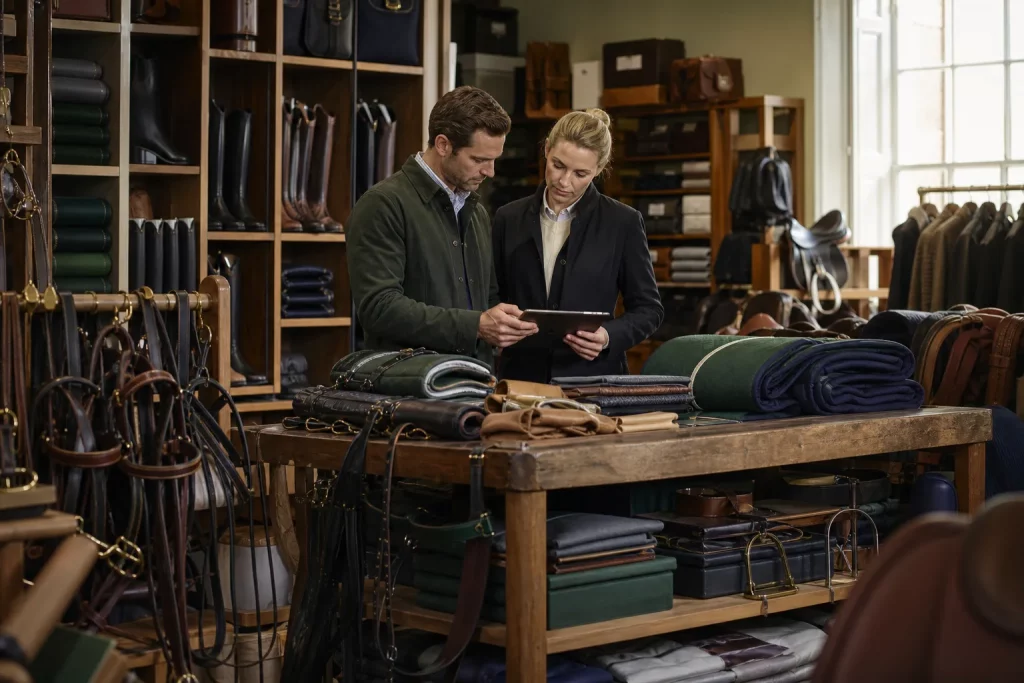
Riding tights manufacturers can help equestrian retailers, private-label brands and distributors develop technical riding leggings for training, competition, leisure riding or wider activewear collections. This guide explains what to assess when sourcing a manufacturer, which product and development questions to ask, and how EquiGuild helps buyers discover relevant suppliers by capability and sourcing requirement.
Riding tights sit between equestrian apparel and technical sportswear. A suitable manufacturing partner therefore needs to understand more than basic cut-and-sew production: fabric behaviour, fit in the saddle, waistband construction, pocket placement, grip applications, decoration, grading and repeat production all affect the finished product.
Last reviewed: September 2026
What are riding tights?
Riding tights are close-fitting riding trousers usually made from knitted stretch fabrics rather than the woven fabrics traditionally associated with riding breeches. They may be designed for schooling, hacking, competition, yard work, travel or everyday equestrian wear.
Depending on the product brief, riding tights can include features such as:
- Four-way stretch for movement in the saddle and while mounting or dismounting.
- A high-rise or supportive waistband intended to remain stable during riding.
- Mobile-phone or utility pockets positioned for practical access.
- Knee patches or full-seat grip systems for rider stability.
- Moisture-management, quick-drying or temperature-management fabric specifications.
- Reflective details, printed branding, embroidery, contrast panels or decorative trims.
- Different lengths, leg openings and fits for adults, children or plus-size customers.
Not every manufacturer will offer every feature. Buyers should treat these as possible specification areas to discuss rather than assumed capabilities.
What buyers should look for in riding tights manufacturers
1. Relevant product-development experience
Ask whether the manufacturer has experience producing close-fitting stretch garments, sports leggings, equestrian clothing or comparable performance apparel. A factory that mainly produces loose woven garments may not be the right fit for a riding tight requiring accurate stretch recovery, body mapping or grip placement.
Request examples of comparable work where commercially confidential information allows. Useful evidence may include a product catalogue, sample photographs, technical packs, fabric cards or a discussion of the construction methods used. A supplier profile can help with initial discovery, but buyers should confirm current capabilities directly before placing an order.
2. Fabric performance and consistency
Fabric selection affects fit, opacity, comfort, durability and the appearance of the garment after repeated wear and washing. Buyers should discuss fibre composition, fabric weight, stretch direction, recovery, pilling resistance, colourfastness and shrinkage rather than relying only on descriptions such as “premium” or “technical”.
The Equestrian Research Atlas research on technical fabrics in riding clothing provides useful background on fibres, stretch, recovery, moisture management, waterproofing, durability and garment performance. It can help buyers turn a general product idea into clearer questions for a manufacturer.
For example, “a breathable riding tight” is a broad marketing description. A stronger brief might specify the intended use, fabric construction, hand feel, opacity standard, stretch requirement and testing or review process expected before approval. The manufacturer may then suggest suitable materials, but the final decision should reflect the product’s retail positioning and target customer.
3. Construction suitable for riding movement
Riding tights need to remain comfortable when the rider is seated, standing in the stirrups, walking or bending. Important construction points include seam placement, gusset design, rise length, waistband recovery, leg opening tension and the interaction between the fabric and any seat grip.
Ask the manufacturer how prototypes are assessed. A sample that looks correct on a flat table may behave differently when worn in a riding position. Fit reviews should consider movement, waistband roll, fabric transparency under tension, seam pressure and whether pockets remain usable without interfering with the rider or saddle.
4. Grip and reinforcement options
Some riding tights use silicone, rubberised, printed or other grip systems at the knee or seat. These options can differ in appearance, hand feel, flexibility, adhesion, wash performance and cost. They can also change the way the garment feels against a saddle.
Ask for details about the grip material, application process, artwork limitations, minimum repeat size, wash-care instructions and expected durability. If the product is intended for regular schooling or intensive use, arrange practical wear testing rather than approving the feature solely from a visual sample.
Manufacturer, supplier and private-label partner: what is the difference?
The terms used in apparel sourcing are not always consistent, so buyers should clarify the commercial role of every prospective partner.
- Manufacturer: Usually refers to a business involved in making the garment. It may cut, sew, print, finish or pack products itself, or may coordinate some stages through approved production partners.
- Supplier: A broader term that may include manufacturers, wholesalers, agents, distributors or businesses supplying products and materials.
- Private-label partner: A supplier that produces goods for sale under the buyer’s own brand. The level of support may range from basic logo application to full product development, pattern work, packaging and production.
- Agent or sourcing intermediary: A business that introduces buyers to factories or coordinates communication and production. Buyers should establish who holds responsibility for specifications, quality control and delivery.
These categories can overlap. The key questions are who will manufacture the product, who owns the patterns and approved specifications, who manages subcontractors, and who is responsible if a batch does not meet the agreed standard.
Buyers comparing wider clothing options can also review the EquiGuild guide to equestrian clothing manufacturers or explore private-label equestrian clothing when developing a branded collection beyond riding tights.
Sourcing considerations for riding tights
Define the customer and use case first
A riding tight for hot-weather schooling may require a different fabric and construction from a winter training tight. A competition-oriented product may prioritise a clean silhouette and discreet branding, while a leisure product may focus on pockets, softness and everyday versatility.
Before contacting manufacturers, record the intended customer, riding discipline, climate, season, price positioning, size range, colour palette and expected retail channel. Also identify whether the garment must coordinate with a wider collection. A clear brief makes supplier responses easier to compare.
Write a practical product specification
A specification or tech pack might cover:
- Flat sketches, measurements and points of measure.
- Size range and grading expectations.
- Fabric composition, weight, stretch and colour references.
- Waistband height, elastic requirements and drawcord details.
- Pocket dimensions and positions.
- Knee or full-seat grip artwork and placement.
- Seam construction, thread, labels and care instructions.
- Logo artwork, print methods, embroidery or trims.
- Packaging, folding, carton marking and shipping requirements.
It is reasonable to ask a manufacturer to advise on feasibility. A specification should be detailed enough to control the product but flexible enough to allow technical improvements that do not compromise the intended fit or performance.
Check labelling and product information
Fibre-content information is an important part of apparel compliance and customer communication. UK buyers should review the official GOV.UK guidance on textile labelling when deciding what information is required and who is responsible for providing it.
Discuss the wording and placement of fibre labels, care labels, country-of-origin information where applicable, size labels, brand labels and batch or style references. The manufacturer may supply or sew labels, but the brand or retailer remains responsible for ensuring that the final product information is appropriate for the markets in which it is sold.
Be precise with performance and environmental claims
Terms such as moisture-wicking, breathable, recycled, sustainable, durable or quick-drying can mean different things to different suppliers. Ask what the claim is based on, whether the fabric mill provides supporting documentation, and whether testing has been conducted under a relevant method.
For environmental statements, consult the CMA guidance on environmental claims in fashion retail. Claims should be accurate, clear and supported rather than presented as broad impressions. A recycled fibre content claim, for example, should not automatically become an unqualified claim about the entire garment’s environmental impact.
For wider context on textile construction, coatings, laminates and performance testing, buyers may also consult the Equestrian Research Atlas research on technical textiles used in horse equipment. Although riding tights are rider garments rather than horse equipment, the discussion can help structure conversations about materials, construction and testing.
MOQ, sampling and product development questions
Minimum order quantities vary by manufacturer, fabric, colour, decoration method and production model. Do not assume that a stated MOQ applies equally to every style or colour. Ask whether quantities are calculated per style, colour, size run or total order, and whether custom fabric development creates a separate threshold.
Useful questions include:
- What is the MOQ for an existing design with private branding?
- What changes if the buyer needs a new pattern, pocket layout or grip artwork?
- Can the manufacturer produce a development sample before bulk approval?
- How many sample revisions are normally needed for fit and construction?
- Are sample fees, pattern fees, artwork fees or fabric-development charges separate?
- Can the buyer approve a pre-production sample before the full run?
- What inspection or quality-control process is used before dispatch?
For a first collection, it can be commercially useful to separate essential customisation from optional features. A standard base pattern with custom colours and branding may be a simpler starting point than developing a completely new garment, although this depends on the supplier’s model and the brand’s differentiation requirements.
Lead times, quality control and repeat orders
Lead time should be discussed as a sequence rather than a single number. Development, fabric booking, sample approval, bulk production, inspection, packing and freight may each affect the delivery date. Ask when the clock starts and what events can move the schedule.
Clarify how the manufacturer handles shade variation, fabric substitutions, measurement tolerances, print registration, grip adhesion, stitching faults and missing components. A written approval process is especially important when a product contains multiple materials or outsourced decoration.
Repeat orders also deserve attention. Ask whether the same fabric mill, dye lot process, pattern version and trim specification can be maintained. If a fabric is discontinued, the supplier should explain how alternatives will be proposed and approved. Keeping a record of the approved sample, measurement chart, artwork, fabric details and packaging specification can reduce ambiguity on future orders.
Relevant suppliers and brands on EquiGuild
EquiGuild supports trade discovery across equestrian clothing and related sourcing categories. The following live supplier profile is available on the site:
- Radhika Print Tex — review the profile for the information supplied by the business, then contact the supplier directly to confirm whether its current services, product scope, development process and order terms match your riding tights brief.
The profile should be treated as a starting point for supplier discovery, not as a substitute for due diligence. Buyers should confirm capabilities, sampling arrangements, compliance responsibilities, MOQ, lead time, quality procedures and commercial terms directly with the supplier.
For adjacent sourcing requirements, EquiGuild also provides guides to equestrian clothing, riding wear and brands, riding breeches manufacturers and riding shirts manufacturers. These categories can be useful when building a coordinated rider collection rather than sourcing tights as a standalone product.
How EquiGuild helps buyers discover manufacturers
EquiGuild is an equestrian trade network designed to help buyers find relevant suppliers, manufacturers and brands by capability and sourcing requirement. For riding tights, that means starting with the product brief and then reviewing potentially relevant businesses rather than contacting an undifferentiated list of clothing companies.
Buyers can use EquiGuild discovery pages and supplier profiles to structure initial research, identify adjacent product categories and create a shortlist for direct enquiries. The next step remains a buyer-led assessment: compare responses, request samples where appropriate, confirm documentation and decide whether the supplier fits the required product, market and commercial model.
When contacting a prospective manufacturer, send a concise brief covering the intended use, fabric expectations, size range, branding, target quantity, delivery market and desired launch timing. This gives the supplier enough context to respond meaningfully and helps reveal which questions need further technical discussion.
FAQs about riding tights manufacturers
Can a riding tights manufacturer develop a completely new design?
Some manufacturers may support new patterns, custom pocket layouts, grip artwork and fabric selection, while others may work from existing styles. Confirm design-development services, fees, sample revisions and ownership of patterns before proceeding.
What fabric is best for riding tights?
There is no single best fabric for every use. The appropriate choice depends on climate, stretch and recovery, opacity, durability, moisture management, hand feel, price position and intended riding activity. Ask for technical details and assess samples in the intended fit.
Do riding tights need a full-seat grip?
Not necessarily. A full-seat grip may suit some training or stability-focused products, while a knee grip or grip-free design may be more appropriate for another customer or discipline. The decision should reflect the product brief and practical wear testing.
How can I compare manufacturers fairly?
Send comparable information to each supplier and record responses against the same criteria: product experience, sample process, fabric options, customisation, MOQ, lead time, quality control, labelling responsibilities and communication. Do not compare price alone before confirming that the specifications are equivalent.
Who is responsible for textile labels and product claims?
Responsibility depends on the supply arrangement and market, but the brand or retailer should not assume that the manufacturer’s wording is automatically compliant. Review fibre labels and claims carefully, use the relevant official guidance, and retain supporting information for any material or environmental statement.
Effective sourcing starts with a clear riding tights specification and a realistic understanding of what the chosen manufacturer can deliver. EquiGuild can support the discovery stage, while direct supplier discussions, sampling and documented approvals help buyers turn a promising contact into a dependable production relationship.
Ready to find the right clothing supplier or brand?
Move from research to live supplier discovery. Compare relevant businesses, explore existing clothing and brand categories, or turn a product idea into a sourcing brief.
Research behind this guide
This guide is supported by EquiGuild editorial research, the Equestrian Research Atlas and current UK guidance. Supplier listings remain separate commercial profiles and should be checked directly before trading.
- Equestrian Research Atlas — Technical Fabrics in Riding Clothing
Research on fibres, stretch, recovery, moisture management, waterproofing, durability and garment performance in riding clothing. - Equestrian Research Atlas — Technical Textiles Used in Horse Equipment
Research on textile construction, coatings, laminates, testing and product performance. - GOV.UK — Textile labelling
Official UK guidance on fibre-content labelling responsibilities for textile manufacturers and retailers. - CMA / GOV.UK — Fashion retail: consumer law when making green claims
Official guidance relevant to environmental and fabric-related claims in fashion retail. - EquiGuild — Equestrian Brands
Existing EquiGuild brand discovery and trade sourcing guide. - EquiGuild — Riding Wear Manufacturers
Existing EquiGuild manufacturer discovery page for riding wear. - EquiGuild — Equestrian Clothing Wholesalers
Existing EquiGuild wholesale clothing sourcing page.
Cite this guide
EquiGuild editorial reference · Last updated 24 September 2026
Canonical source: https://equiguild.co.uk/equestrian-suppliers/rider-clothing-footwear/riding-tights-manufacturers/