

Transport, Shipping & Logistics
Find transport, freight, customs, warehousing and fulfilment partners for equestrian products. Compare UK and international suppliers equipped to move tack, horsewear, feed, stable equipment, retail stock and trade consignments reliably.
Transport, Shipping & Logistics suppliers
This category is open for supplier profiles. Featured listings receive enhanced placement.
List your businessWhat buyers need to know
Equestrian transport, shipping and logistics suppliers help brands, retailers, manufacturers and importers move commercial horse-industry goods from factory or warehouse to trade and consumer destinations. The right partner depends on the consignment: parcels for direct-to-rider orders, pallet networks for replenishment, freight forwarding for international movements, and 3PL providers for storage and fulfilment. UK buyers should assess a supplier’s experience with product dimensions, fragile or high-value goods, customs data, delivery coverage, stock systems and returns handling. For feed, supplements, battery-powered equipment or animal-origin products, confirm requirements before goods are booked rather than treating compliance as a last-minute freight issue.
- A carrier moves the consignment, while a freight forwarder coordinates international transport and a 3PL typically combines warehousing, fulfilment and distribution.
- Parcel, pallet, part-load and full-load road services suit different order profiles; large stable equipment and repeat trade replenishment should not automatically be priced as parcel freight.
- For Great Britain imports, customs declarations require accurate goods information, including commodity codes; cross-border commercial invoices should match the shipment and agreed sale terms.
- Incoterms allocate agreed tasks, costs and risk between buyer and seller, but they do not replace a clear freight brief, cargo insurance decision or customs plan.
- Solid-wood pallets, crates and dunnage used internationally may need ISPM 15 treatment and marking, including on movements between Great Britain and the EU.
- Feed, certain animal-origin ingredients, aerosols and lithium-battery products can require additional checks, declarations, packing or carrier approval depending on the goods and route.
Guide summary
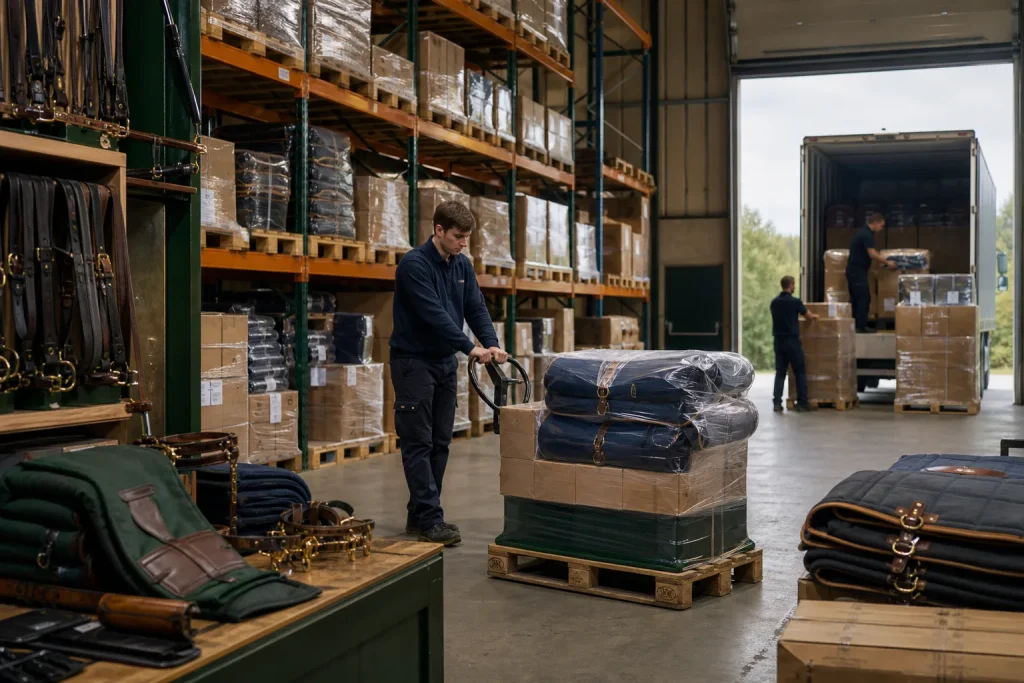
Equestrian transport, shipping and logistics covers the commercial movement of horse-industry products rather than the transport of live horses. This category brings together UK and international suppliers handling freight, customs, warehousing, fulfilment, distribution and final-mile delivery for tack, saddlery, rugs, rider clothing, stable equipment, feed, supplements, grooming products and retail stock.
For buyers, the priority is not simply finding the lowest carriage rate. A suitable logistics partner must be able to move the required product mix, protect it in transit, provide the right level of tracking and stock visibility, and manage the border, delivery and returns requirements attached to the route. Use this hub to identify specialists in equestrian product shipping, freight forwarding, fulfilment and import-export support.
Find the right type of equestrian logistics supplier
The term logistics can cover several distinct services. Clarifying which part of the supply chain needs support will make supplier comparison faster and prevent gaps between factory collection, customs clearance, warehousing and final delivery.
Carriers, freight forwarders and customs support
- Parcel and courier providers are suited to individual ecommerce orders, samples, small replacement parts and lightweight trade consignments.
- Pallet networks and road freight operators handle larger boxed stock, feed deliveries, displays, stable fittings and regular UK or European replenishment loads.
- Equestrian freight forwarders arrange and coordinate international road, air or sea freight, often working across a network of carriers, agents and customs intermediaries.
- Customs and import-export services support declarations, commodity data, documentation and border processes. Their role should be defined clearly: a freight forwarder may offer customs support, but the importer and exporter still need accurate product information.
- Distribution and last-mile delivery specialists focus on delivery appointments, regional coverage, residential access, bulky-goods handling and return collections.
Warehousing, fulfilment and 3PL operations
An equestrian warehousing and 3PL supplier stores stock and performs operational work such as receipting, put-away, picking, packing, dispatch, returns processing and inventory reporting. This can be particularly valuable for overseas brands entering the UK market, retailers operating multiple sales channels, or manufacturers wanting to separate production from order fulfilment.
Ask whether the provider can manage SKU-level stock control, batch or best-before data where relevant, barcode standards, trade and direct-to-consumer orders, branded packing materials, marketplace routing requirements and seasonal peaks. A warehouse designed only for full-pallet business may not be appropriate for a high-volume tack or horsewear ecommerce operation with varied order sizes.
Choosing transport for equestrian products
Mode selection should follow the product, delivery promise, order quantity and total landed-cost objective. It is rarely sensible to choose air, sea or road freight in isolation from packaging, stockholding and customs planning.
Road freight for UK and European deliveries
Road transport is often the practical choice for UK distribution and many European consignments. It can range from a small parcel service to groupage, palletised part-load freight or a dedicated full vehicle. Groupage can work well for mixed retail stock and moderate-volume imports, while dedicated transport may suit urgent, high-value or time-sensitive consignments where fewer handling points are important.
Give the supplier accurate carton and pallet dimensions, gross weights, stackability, collection constraints and delivery-site information. A saddle rack, stable door, jump wing or bulk bedding accessory may have an awkward cubic profile despite a modest weight. For rural delivery locations, check vehicle access, tail-lift needs, booking requirements and whether delivery is kerbside or includes further placement.
Air freight for urgent products and launches
Air freight for equestrian products is normally used where speed, stock availability or event deadlines justify the additional cost. It may be suitable for launch stock, premium lightweight goods, replacement components, samples or urgent replenishment. It is less likely to be economical for bulky rugs, low-value stable hardware or dense feed products unless there is a compelling commercial reason.
Ask for chargeable-weight calculations before comparing quotations, as air freight is influenced by both actual weight and volume. Products containing lithium batteries, aerosols, certain cleaning chemicals or gas cartridges should be declared early. Air carriers apply specific dangerous-goods requirements, so do not assume that a product accepted by a domestic courier can travel internationally by air without further review.
Sea freight for planned international supply
Sea freight is usually considered for larger, planned international movements where transit time can be absorbed into purchasing and inventory plans. Buyers may choose a full container load for a high-volume shipment or less-than-container-load consolidation when sharing container space. The apparent freight saving should be assessed alongside port fees, destination handling, customs clearance, cargo availability dates, warehousing capacity and the risk of stock arriving later than forecast.
For palletised or crated goods, specify who is responsible for export-standard packing and whether solid-wood pallets, crates or dunnage meet the destination’s requirements. Wood packaging used in international trade may need ISPM 15 treatment and marking; it is a packaging issue that can delay an otherwise correctly documented shipment.
Customs, shipping documents and international trade terms
International equestrian shipping succeeds or fails on the quality of the goods data as much as on physical transport. Product descriptions such as “horse items” or “equestrian accessories” are too broad for reliable customs processing. A freight partner needs a clear description of what the item is, what it is made from, its intended use, origin, value, quantity, weights and the relevant commodity classification.
Build a usable shipping data pack
Before requesting an international quotation, prepare a repeatable data pack for each product group. Include the supplier and consignee details, commercial invoice information, country of origin, itemised values, quantities, carton or pallet count, gross and net weights, dimensions and commodity codes. For imports into Great Britain, businesses generally need a GB Economic Operators Registration and Identification number and must ensure customs declarations use accurate commodity information.
Commercial invoices should align with the actual shipment and sales agreement. If the goods are supplied under an agreed Incoterm, show the selected term and named place precisely. Incoterms help allocate tasks, costs and risk between buyer and seller, but they do not determine the correct customs classification or remove the need to agree who provides documents, pays duties and taxes, arranges insurance and responds if a consignment is held.
Products requiring an earlier compliance conversation
Most equestrian hard goods can be handled as conventional commercial freight when accurately classified and packed. However, buyers should involve a knowledgeable customs or compliance specialist early where stock includes feed, supplements with regulated ingredients, animal-origin materials, chemical products, batteries or restricted materials. Import controls can depend on the exact commodity, country of dispatch, origin and risk category. The same principle applies to returned stock, temporary samples, trade-show goods and warranty replacements, which may need a different customs approach from a standard permanent sale.
What good equestrian fulfilment looks like
Equestrian retail brings operational challenges that a general fulfilment quote may overlook. Order sizes can vary sharply, from a single pair of gloves to a saddle, a set of rugs, a pallet of feed tubs or a multi-carton yard order. Seasonality can be pronounced around weather changes, show calendars, Christmas gifting and competition launches. Returns may involve size exchanges, damaged packaging, used-product inspection or product-specific hygiene policies.
When evaluating equestrian logistics and fulfilment suppliers, ask how they handle long or irregular cartons, premium presentation, fragile leatherwork, barcode exceptions, customer delivery notifications and returns grading. Establish what is measured: inventory accuracy, cut-off performance, dispatch turnaround, delivery exceptions, lost-stock investigations and response times. A service-level agreement should say what happens when stock arrives short, a carton is damaged, an order misses its agreed cut-off or a customer disputes delivery.
How to compare suppliers beyond the headline rate
A low base price can conceal surcharges and operational limits. Request a cost model that separates collection, freight, fuel or energy adjustments, customs clearance, duty and tax disbursement charges, terminal or handling fees, delivery-area surcharges, storage, pick-and-pack charges, returns fees and any account-management or systems costs. Compare like for like on transit expectations, not only estimated transit days.
Also establish liability and insurance arrangements. Carrier liability can be limited and may not match the replacement value of high-value saddles, specialist tack, electronic equipment or branded launch stock. Ask who has responsibility at each handover, what evidence is needed for a claim, how quickly damage must be reported and whether separate cargo cover is appropriate for the commercial risk.
Questions to ask before appointing a logistics partner
- Which product categories, dimensions and shipment profiles do you routinely handle?
- Can you quote separately for parcel, pallet, groupage, dedicated road, air and sea options where appropriate?
- Who prepares customs entries, and what product data and authorisations do you require from us?
- How do you manage stock accuracy, batch information, ecommerce integrations and trade-order requirements?
- What delivery coverage, rural-access options, booking services and proof-of-delivery standards do you offer?
- Which surcharges, clearance fees, storage costs and return charges apply beyond the headline rate?
- How are loss, damage, delivery failure and customs holds escalated and resolved?
Browse EquiGuild listings to compare providers across air freight, road freight, sea freight, customs support, international shipping, warehousing, 3PL fulfilment and last-mile delivery. Assess each supplier against your actual product profile and route rather than assuming one logistics model will suit every equestrian order.
Cite this guide
EquiGuild editorial reference · Last updated 5 November 2026
Canonical source: https://equiguild.co.uk/equestrian-suppliers/transport-shipping-logistics/
Research provenance (6 sources)
Related sourcing searches
Buyers using EquiGuild also search for international horse transport companies, equine logistics, horse transport companies, equine transport. Browse the supplier directory to compare relevant businesses, capabilities and trade options.
Buyer checklist
- Define the product mix, order volumes, dimensions, weights, origin countries and required delivery destinations.
- Separate parcel, pallet, bulky-goods, urgent and international requirements rather than requesting one generic logistics quote.
- Provide precise product descriptions, origin details, values, weights, package counts and commodity codes for cross-border movements.
- Agree the Incoterm, named place, customs responsibilities, duty and tax treatment, and cargo-risk arrangements in writing.
- Check whether feed, supplements, animal-origin materials, aerosols, chemicals or lithium batteries need specialist handling or pre-approval.
- Confirm warehouse capabilities for barcodes, batch data, ecommerce integrations, branded packing, trade orders and returns processing.
- Request a complete charging schedule covering freight, handling, customs, storage, fulfilment, rural delivery and returns.
- Review escalation processes, delivery proof, claims timeframes and service-level reporting before committing stock.
Specialist supplier categories
Sources used for this guide
- Import goods into the UK: step by stepGOV.UKUsed for Great Britain import requirements, including EORI registration and commodity-code information.
- How to create a commercial invoice for exportBusiness.gov.ukUsed for the practical information expected on export commercial invoices, including goods descriptions, weights, values, origin and Incoterms.
- Customs valuation: IncotermsHM Revenue & CustomsUsed to explain the role of Incoterms in allocating delivery tasks, costs and risk in trade contracts.
- Wood packaging goods for import and exportGOV.UKUsed for ISPM 15 considerations affecting solid-wood pallets, crates and dunnage used in international shipments.
- Dangerous GoodsInternational Air Transport AssociationUsed for air-freight handling considerations for dangerous goods, including lithium batteries.
- Notifying authorities of high-risk food and feed importsGOV.UKUsed for the distinction that some feed and animal-origin consignments can have additional Great Britain import notification requirements.
Sources support the editorial guide; supplier listings are separate commercial profiles and should be independently checked before trading.
Frequently asked questions
What is included in equestrian transport, shipping and logistics?
This category covers commercial goods such as tack, horsewear, feed, supplements, stable equipment, rider clothing and retail stock. Services can include collection, freight, customs handling, storage, fulfilment, distribution, delivery and returns. It does not refer to the transport of live horses.
Should I use a freight forwarder or a courier for equestrian products?
Use a courier for smaller, straightforward parcel consignments where the service and destination are already supported. A freight forwarder is more useful for international, palletised, urgent, bulky or multi-stage shipments that need transport coordination, customs support or a choice of air, sea and road options.
What is the difference between a 3PL and a warehouse?
A warehouse may provide storage alone, whereas a third-party logistics provider normally adds operational services such as goods-in, inventory management, picking, packing, dispatch, returns and reporting. The exact scope varies, so buyers should confirm which activities, systems and charges are included.
What paperwork is needed to ship equestrian goods internationally?
Requirements depend on the route and commodity, but usually start with accurate commercial documentation, product descriptions, values, origin information, package details and commodity codes. The buyer and seller should also agree the Incoterm and clarify who is responsible for customs declarations, duties, taxes and freight costs.
Can feed and supplements be shipped internationally with other equestrian stock?
They can sometimes travel in mixed commercial consignments, but they should not be treated as ordinary hard goods without checking the exact ingredients, classification, origin and destination controls. Feed, high-risk food and products containing animal-origin materials may have additional import conditions or notification requirements.
Why does packaging matter when importing or exporting equestrian goods?
Good packaging protects leatherwork, fragile fittings, retail cartons and irregular-shaped products during multiple handling stages. Where solid-wood pallets, crates or dunnage are used internationally, ISPM 15 requirements may also apply, so responsibility for compliant packaging should be agreed before collection.